European Service Module engines
Artist impression of Artemis II: Orion and its European Service Module flying around the Moon. The lunar flyby will occur around halfway through the mission, where Orion and its crew will fly around 7500 km beyond the Moon. They will be the first humans to see the lunar far side with their own eyes in over half a century, since the Apollo 17 mission in 1972.
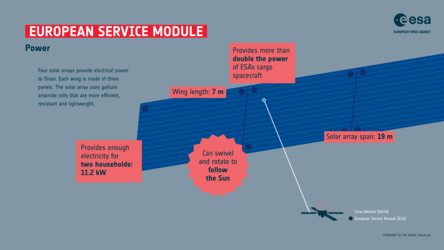
The European Service Module is the powerhouse of the Orion spacecraft that will ferry astronauts towards the Moon and back during Artemis II. Our module provides life support for the astronauts - air, water, and a comfortable temperature - as well as electricity with its four solar arrays.
Our European Service Module will also propel Orion through deep space using its 33 engines. The module has three types of engines that work together, each with a specific role during the mission. A single main engine delivers the large changes in speed needed to send Orion towards the Moon. It is supported by eight auxiliary engines, which are used for orbital corrections and can back up the main engine if needed. For precise control, 24 smaller reaction control system engines, arranged in six pods, are used to rotate and orient the spacecraft. Firing individually or in combination, they allow Orion to adjust its position with exceptional accuracy.
The main engine is no stranger to space – it is a repurposed Space Shuttle orbital manoeuvering system engine which has already flown on six missions between 2000 and 2002. Now fully tested, refurbished and integrated into Orion, it brings years of proven performance to a new era of human exploration.