


CM25 – Strengthen European autonomy and resilience
For its security and well-being, Europe needs to be certain of its ability to use space. This means always being able to launch satellites and other spacecraft, and always being able to retrieve data from space when and where it is needed.
These technologies will help to reduce risks to individual Europeans in the event of natural or manmade crises.


Access the video
Europe’s launchers Ariane 6 and Vega-C guarantee European access to space. In the coming years, they will be adapted to reduce costs and increase the number of launches possible annually. Europe will also develop the ASTRIS vehicle, initially as an extra stage to help deliver payloads for Ariane 6, and later as an orbital logistics vehicle. This flexibility will open up the Solar System to a wider variety of payloads.
Europe’s Spaceport in French Guiana will undergo some upgrades, including increasing the production of more environmentally friendly hydrogen.
This year’s Ministerial Council will be decision time for the European Launcher Challenge – a competition to select future launch services. Five finalists will be reviewed by the Member States, with potential funding of up to €169 million available to each. Other components of launchers and space logistics are also being developed under the Future Launchers Preparatory Programme, while Space Rider, a reusable orbital laboratory is being prepared for its first use in space in 2027.
Using the best of space for life on Earth
Space offers great opportunities using connectivity, navigation technology (that brings together positioning, navigation and timing) and Earth observation. Life in the 21st century has been transformed by our ability to find our way and connect with each other easily. Different combinations of space applications help to make farming more efficient, make transport safer, and help environmental planning, to name just a few examples. ESA’s ARTES 4.0 programme helps to advance the best ideas for using space applications and support the European companies seeking to commercialise them.
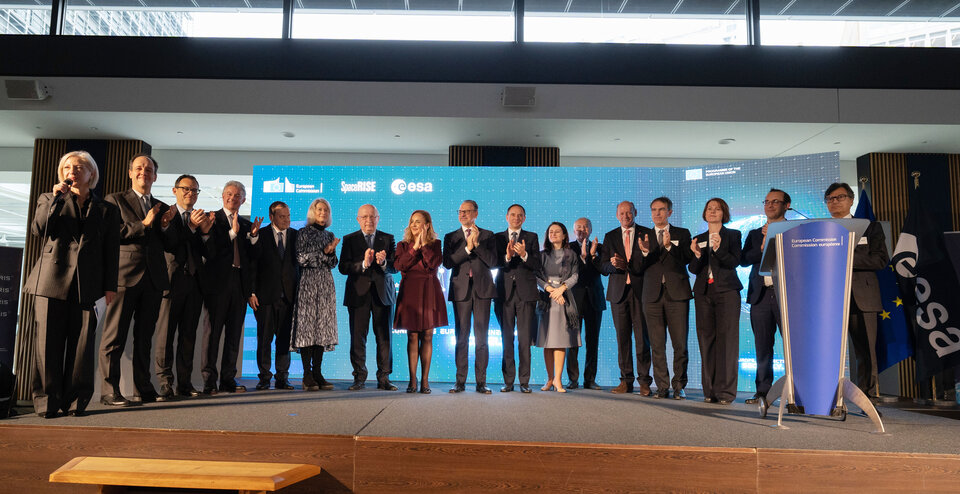
To ensure that we can keep using all of these tools, we must keep our space data safe and secure. We can also benefit from making faster more reliable connections. The European Union’s programme IRIS2 will help protect Europe’s data and communication assets. ESA is monitoring the design and development of this new satellite constellation that is being built by an industrial consortium named SpaceRISE.
ESA's Navigation Innovation and Support Programme – NAVISP- helps to develop new products and services using navigation technologies, including giving suitable support to each Member State for national activities. The FutureNAV programme is preparing for the applications and capabilities still to come – for example through supplementing traditional global navigations systems with satellites in low Earth orbit, and improving navigation accuracy as well as contributing to Earth sciences. Reliable Earth observation data is essential to combining space applications for everyday life. The continued development of the Copernicus space segment will support the best Earth observation constellation in the world.
Managing new realities in security

The combination of navigation, connectivity and Earth observation for safety and security applications is the backbone of the European Resilience from Space initiative. To improve our ability to mitigate and manage emergencies and use the best assets of space to protect Europeans, ESA is studying an architecture to bring together space applications to improve security on the ground in times of geopolitical crises. This system of systems includes enhanced Earth observation capabilities to allow for up-to-date high-resolution imagery to be received in a timely way for any location on the planet. The Earth observation component would then be connected to IRIS2 and its successors to ensure safe passage for data from space and between users. The third component would accelerate the implementation of navigation from low Earth orbit as is under preparation in the FutureNAV programme, to make sure that stable navigation systems are always available even when signals from other sources may be disrupted by environmental factors or malicious activities. This infrastructure for resilience will ensure that space plays its full part in keeping Europe safe and secure.
Strengthening European technology sovereignty
ESA’s Technology Directorate is working to increase autonomy by ensuring access to essential components, and developing cybersecurity as well as anti-jamming and anti-spoofing technologies. Under the General Support Technology Programme, ESA is boosting European non-dependence through mastering key capabilities and developing critical technologies for the missions of the future.